

What Is AI-Driven Marketing? A Practical Guide for Small Businesses
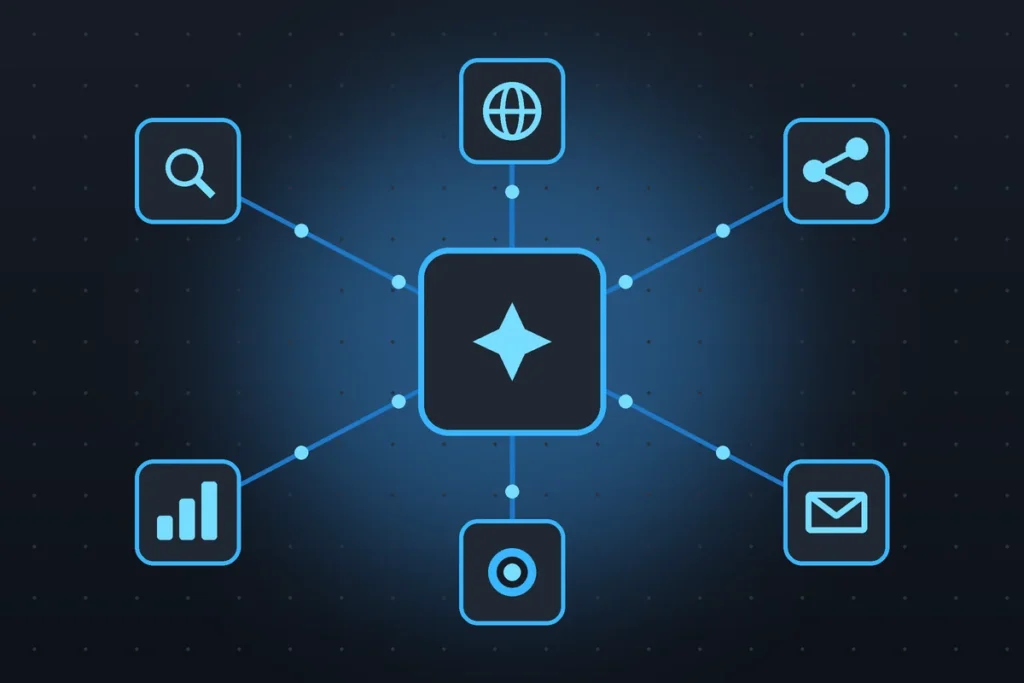
AI-driven marketing for small businesses is a practical way to run marketing consistently: AI carries out and schedules the research, monitoring, tracking, first drafts and reporting, while people set the strategy and approve anything that goes public. It is not a promise that software will replace your team. It is a system that keeps the work moving even when that team is small.
This guide explains what that system looks like, how it works day to day, and how a small business can start without overhauling everything at once. If you already know you want help putting one in place, AISEO Tech offers AI-driven marketing solutions as a one-time setup you run yourselves, or as a managed service we run for you.
What AI-driven marketing actually means
Many businesses first meet AI as a writing assistant. That can save time, but it is only a slice of the work. Marketing still needs research, tracking, budget checks, content that matches your offer, and a clear view of which activity leads to enquiries or sales.
In an AI-driven marketing system, those repetitive tasks are carried out and scheduled with AI, then reviewed by a person. The aim is consistency: the same checks happen on time, the same reports arrive on a cadence you choose, and nothing public goes out without approval.
In practice, the system usually covers:
- An initial audit of your website, tracking, campaigns and competitors, so you start from a clear picture rather than guesswork.
- Agreed KPIs, so everyone knows what “working” means — typically enquiries, cost per lead, and which channels produce them.
- Lead and conversion tracking, so form fills, calls and purchases can be tied back to the pages and campaigns that produced them.
- Channel work such as SEO, paid search, social media and email, with first drafts and optimisation ideas prepared for a person to review.
- Scheduled reports that show performance and recommend the next period’s actions.
You keep ownership of your accounts, data and workflows. The tools sit around the systems you already use where possible, rather than locking you into a private stack you cannot leave.
How AI-driven marketing works in practice
The sequence is straightforward. The detail changes with your business, but the stages stay the same.
1. Audit and plan
The work starts with what you already have: your website, analytics, ad accounts, search performance and the way enquiries arrive today. Competitor research sits alongside this, so you can see how you are found compared with others in your market. The output is a short plan: the KPIs to target, the tracking to fix, and the channels to set up first.
2. Set up tracking and the core system
Before more campaigns are added, tracking has to be trustworthy. That means website analytics and conversion tracking are set up so that a form submission, a call or a purchase can be seen in your reports. It also means agreeing how you will reconcile platform-reported conversions with your actual orders or enquiries, because those numbers often differ.
3. Connect your marketing channels
The same system can support search engine optimisation, paid search, social media marketing and email marketing. You do not have to switch everything on at once. Many small businesses start with tracking, reporting and one or two channels, then add more once the first ones are stable.
4. Run the work on a schedule
Budget and enquiry checks can run daily. Rankings and channel data refresh on a regular schedule. Content and campaign changes are drafted, then approved by a person before they go live. This is the part that usually slips when a small team is busy: without a schedule, checks happen only when someone remembers.
5. Report, review and improve
You receive automated, scheduled analysis and reports — weekly, fortnightly or monthly, on the cadence you choose. A useful report does more than repeat last week’s numbers. It should show what changed, why it might have changed, and what to do next. That is why AI marketing KPIs and lead tracking matter as much as the tools themselves.
What stays in human hands
AI is good at collecting data, spotting patterns, preparing first drafts and assembling reports. It is not a substitute for judgement about your offer, your customers or your brand.
People should still:
- Set the strategy, the offer and the budget.
- Approve posts, emails, ads and new pages before they are published.
- Decide how to handle unusual results, such as a sudden drop in enquiries or a campaign that spends quickly.
- Keep the message consistent with how you actually sell and deliver.
At AISEO Tech, that rule is simple: a person approves everything public. Experienced marketers stay in charge. AI does the repetitive work around them.
Why this approach helps small businesses
A small business in India, the US, the UK or Australia often has the same marketing channels as a much larger company, but far less time to operate them. Search, ads, social and email all generate data. Without a system, that data sits unread, and decisions are made from memory or from a single platform’s dashboard.
AI-driven marketing helps in three practical ways:
- Time. Daily checks and first drafts no longer depend on someone finding a spare hour.
- Consistency. Reports arrive on schedule, so you can compare one period with the next.
- Clarity. When tracking is set up properly, you can see which work leads to real enquiries, not only clicks.
It does not remove the need for a clear offer or a website that is fit to convert visitors. If those foundations are weak, the system will make that visible — which is useful, but it is not a substitute for fixing them.
Two ways to put the system in place
The foundation can be the same whether you run it or we do. With AI Marketing Setup, we build the system, train your team and hand it over. With Managed AI Marketing, we build the same system and run it for you on an ongoing basis. The difference is who operates it day to day. We explain that choice in more detail in our comparison of AI Marketing Setup and Managed AI Marketing.
Both options include the audit, competitor research, agreed KPIs, lead tracking, conversion tracking, reconciliation and scheduled reports. You can read the full picture on our page about AI-driven marketing.
A sensible way to get started
You do not need to automate every channel in the first month. A practical starting point is:
- Fix tracking and agree two or three KPIs you will actually use.
- Put a scheduled report in place so you have a baseline.
- Choose one or two channels where you already have activity, and run those through the system first.
- Add more channels once the first ones are stable and the reports make sense to your team.
If you would like help with that plan, contact us. AISEO Tech is based in Bangalore and works with businesses in India, the US, the UK and Australia. Tell us how you run marketing today, and whether you would rather run the system yourselves or have us manage it. There is no obligation.
Frequently asked questions
What is AI-driven marketing in simple terms?
It is a way of running the research, monitoring, tracking, first drafts and reporting behind your marketing with AI, while people still set the strategy and approve anything that goes public.
Is AI-driven marketing only for large companies?
No. Small businesses often gain the most, because a small team cannot check campaigns, rankings and leads every day by hand. A well-set-up system does the repetitive work on a schedule.
Will AI publish posts or ads on its own?
It should not. At AISEO Tech, a person approves posts, emails, ads and new pages before they go live. AI prepares the work; people stay in charge of what the public sees.
How is this different from just using AI to write content?
Writing is only one task. AI-driven marketing also covers audits, competitor research, lead tracking, campaign checks and scheduled reports, so the work is consistent and measured against clear KPIs.

One Response
[…] channels work better when they share the same tracking and KPIs. It sits alongside our guides to what AI-driven marketing is and AI Marketing Setup and Managed AI […]
Comments are closed.