AI Search Visibility: 40% More Citations for Local Teams With Reviews

AI search visibility means giving artificial intelligence systems consistent, machine-readable proof of who you are and why customers trust you, then automating the reputation and content signals that let AI engines cite and recommend you. The approach rests on four pillars: governed entity data, extractable content, reputation automation, and ongoing measurement. Your first move should be an entity-consistency and review-coverage audit before you touch anything else.
TL;DR:
- Consistent entity data and accurate schema markup are essential because AI models rely on structured, machine-readable information to cite your business.
- Reputation signals like review volume, recency, and sentiment, combined with well-managed reply strategies, directly influence AI’s trust and recommendation rate.
- Automating review ingestion, reply workflows, and ongoing content optimization helps maintain visibility and prevents mismatches that can disqualify you from AI citations.
- Building a strong reputation infrastructure must take precedence over content updates, as AI engines prioritize entity accuracy over sheer content volume.
- Regular audits and structured testing across multiple AI platforms are crucial to measure citation frequency, accuracy, share of voice, and ROI over time.
Table of Contents
- Why AI Search Visibility Matters More Than Traditional Rankings
- What Are the Core Components of AI Search Visibility?
- How Do You Build an AI Search Visibility Program Step by Step?
- How Do You Measure AI Search Visibility and Prove ROI?
- Why AISEO Tech and ReviewSync Are Built for This Playbook
- The Part of AI Search Visibility Most Teams Get Backward
- Get Your AI Search Visibility Audit Started
- Sources
Why AI Search Visibility Matters More Than Traditional Rankings
Traditional SEO optimized for a click. AI search visibility optimizes for a citation, and that’s a fundamentally different contest. When an AI engine answers a prospect’s question directly, your business either gets named as the trusted option or it disappears from the conversation entirely. There’s no page two to hide on.
This shift is what industry analysts call Local 5.0: AI models now evaluate connected evidence across your listings, reviews, first-party site, and third-party publishers before recommending you. That means Generative Engine Optimization (GEO) rewards earned media and extractable structure over keyword density. Structured content built around FAQPage and Review schema can increase AI citation probability by up to 40%, according to one industry analysis of reputation signals feeding generative engines.
The business case is straightforward once you consider what changes when a brand shows up inside an AI answer instead of a search results list:
- The recommendation carries implicit third-party trust, since the AI is synthesizing evidence rather than ranking pages.
- Review volume, recency, and sentiment now function as ranking signals, not just social proof.
- Machine-readable accuracy (your name, address, phone, and services matching everywhere) becomes a prerequisite for being cited at all.
Pro Tip: Don’t wait for a full GEO strategy before fixing basic data mismatches. A wrong phone number on one directory can quietly disqualify you from an AI citation before your content even gets evaluated.
The practical consequence: marketing teams can’t treat this as a content project bolted onto existing SEO. It requires investment in reputation infrastructure and structured data as foundational assets, not optional add-ons.
What Are the Core Components of AI Search Visibility?
An AI search visibility program breaks down into four operational layers. Skip one, and the other three underperform.
- Entity foundation. This is your single source of truth: one consistent name, address, and phone number (NAP) across every listing, plus a presence in relevant knowledge graphs. AI systems cross-reference these details automatically, and even minor mismatches lower an AI engine’s confidence in citing you at all.
- Extractable content. FAQPage schema, Review and AggregateRating markup, and short, quotable paragraphs give AI models something concrete to lift and cite. Long, narrative marketing copy without structure is nearly invisible to a generative engine looking for a clean, attributable answer.
- Reputation layer. Review volume and recency matter, but so does how you respond. Automated review replies become indexable content that search engines and AI systems parse for context, provided they stay human-in-loop rather than fully unsupervised. Reply strategy matters too: research on AI-generated responses found that “thinking” replies, the analytical, data-backed kind, often outperform generic template replies on perceived authenticity in negative-review situations, while warmer “feeling” replies still suit routine positive feedback.
- Automation and discovery signals. Tools like IndexNow accelerate how quickly structured data changes get discovered and verified. Pair that with ongoing listings monitoring and an AI agent layer that flags inconsistencies before they compound across dozens of directories.
These four layers aren’t sequential phases you complete once. They’re systems that run in parallel, feeding each other. A review spike without matching schema updates gets missed by AI crawlers just as easily as a schema update without fresh reviews gets ignored for lack of recency.
How Do You Build an AI Search Visibility Program Step by Step?
Here’s the sequence Aiseo runs with clients moving from zero AI presence to a measurable pilot:
- Audit. Check entity matches across every listing, schema coverage on service and location pages, review coverage by platform, existing earned mentions, and basic technical health (crawlability, page speed, mobile rendering).
- Govern. Build a single source of truth, ideally a governed context memory graph linking your knowledge-graph entity, schema markup, listings, and review clusters. Set a change-control process so nobody edits a business name or hours without triggering an update everywhere else.
- Create and publish. Prioritize the FAQ content and short answerable paragraphs your customers actually ask about, then wrap them in Service and Review schema. Add location pages only where you genuinely have distinct local operations, not as a scaling gimmick.
- Automate reputation. Configure review ingestion so incoming feedback routes into a tiered workflow, not a single inbox.
- Test and roll out. Run identical prompts across multiple AI platforms and log the results before declaring the pilot a win.
Two of those steps deserve more detail before you brief an agency:
- Automated reply routing should auto-approve high-scoring positive reviews, draft-and-post neutral ones with light human spot-checks, and queue negative or low-scoring reviews for human review paired with a suggested “thinking” reply template.
- Testing methodology matters more than most teams expect: prompt ChatGPT, Gemini, Perplexity, and Copilot with the same representative customer queries, since each platform sources and weights evidence differently, and a gap on one platform can hide behind strong performance on another.
Set pilot KPIs before launch, not after. A 90-day pilot with a defined sample size gives you a defensible before-and-after comparison instead of an anecdotal “it seems better.”
How Do You Measure AI Search Visibility and Prove ROI?
Four signals separate a real measurement framework from vague optimism: visibility (how often AI engines cite you), share of voice (how often you’re the recommended option versus a competitor), accuracy (whether the AI’s stated facts about you are correct), and opportunity (where the biggest citation gaps sit relative to competitors).
Testing needs structure to be useful. Run the same set of prompts across your platform matrix on a fixed cadence, weekly for high-priority queries and monthly for the long tail, and log every result with timestamp, platform, and prompt wording. Without a uniform prompt set, you’re comparing noise, not trends.
- Track AI-referred conversions separately from organic search conversions in your analytics setup.
- Assign a lead value to AI-driven inquiries so revenue per AI referral becomes a reportable figure.
- Re-run your baseline audit quarterly since AI platform behavior shifts faster than traditional search algorithms.
Statistic Callout: Structured, schema-backed content and consistent entity data can lift AI citation probability by as much as 40% compared to unstructured pages with mismatched business data.
The point of all four metrics together is that visibility without accuracy is a liability. An AI engine that cites you with a wrong price or an outdated service list can damage trust faster than not being cited at all.
Why AISEO Tech and ReviewSync Are Built for This Playbook
This playbook isn’t theoretical for Aiseo. ReviewSync was built specifically to handle the reputation automation layer this article describes: multi-platform review ingestion, sentiment analysis, tiered reply workflows, and review widgets that double as extractable, schema-ready content for your site.
- Multi-platform review monitoring feeds directly into the entity-consistency audits described above.
- Automated, human-in-loop reply drafting maps to the tiered escalation model in the implementation steps.
- Sentiment and citation tracking give you the raw data behind the visibility, share of voice, and accuracy metrics.
| Playbook Layer | ReviewSync Capability |
|---|---|
| Reputation layer | Multi-platform review ingestion and sentiment analysis |
| Automation | Tiered reply drafting with human approval controls |
| Measurement | Sentiment and citation tracking across platforms |
| Extractable content | Review widgets structured for schema markup |
Author Prasad’s work on AI-driven marketing strategy informs the audit framework above; if you want case-study detail on review growth or citation lift for a specific vertical, ask and we’ll pull the relevant metrics.
The Part of AI Search Visibility Most Teams Get Backward
Most teams treat AI search visibility as a content problem: write more FAQ pages, add more schema, hope an AI engine notices. That’s backward. The research is consistent on this point: AI engines weigh entity consistency and reputation signals before they weigh content volume. A business with three mismatched addresses and thin reviews won’t get cited no matter how much schema-wrapped content it publishes.
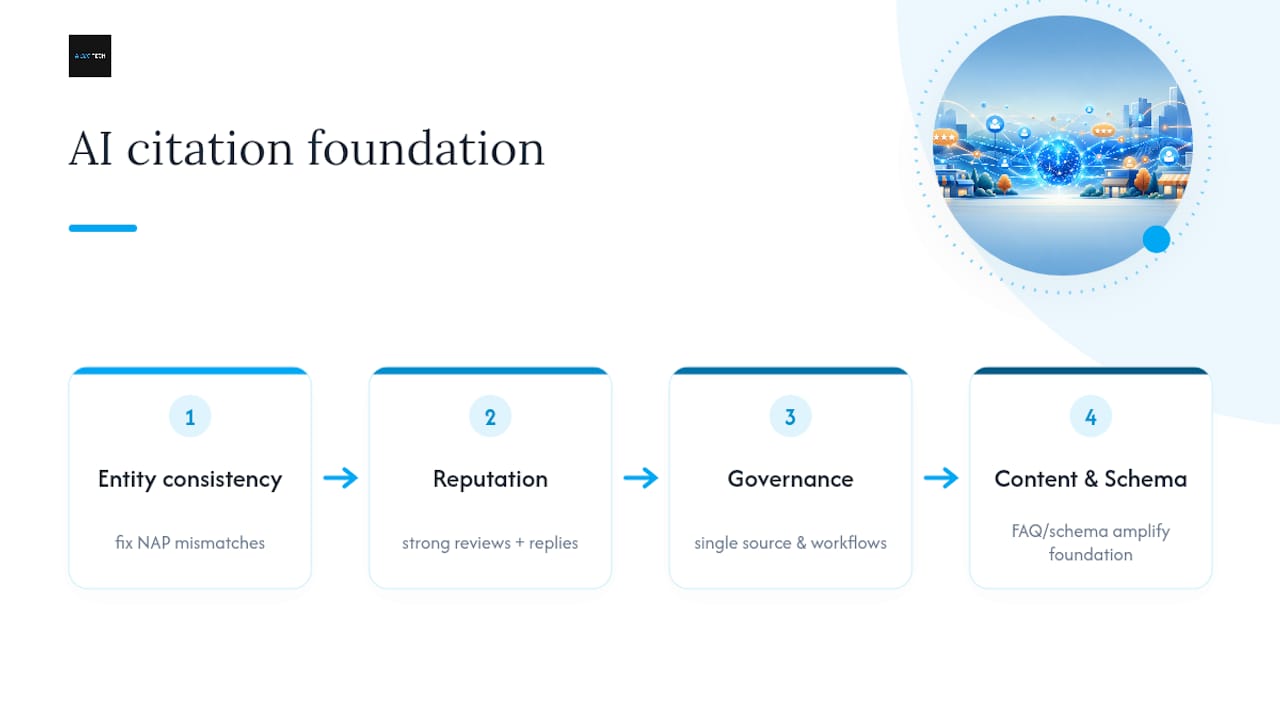
The conventional advice, “just optimize your content for AI,” skips the unglamorous governance work: fixing NAP mismatches, building a single source of truth, and setting reply workflows that don’t collapse the moment volume increases. That work isn’t exciting, but it’s the prerequisite everything else depends on.
If you’re prioritizing one thing first, make it reputation infrastructure. Reviews are both a trust signal and a content asset simultaneously, and tiered automation with human oversight is the only way to scale that without sacrificing authenticity. Schema and FAQ content matter, but they amplify a foundation that either exists or doesn’t.
— Prasad
Get Your AI Search Visibility Audit Started
Aiseo runs the exact audit this article describes: entity-consistency checks, schema coverage review, and reputation gap analysis, then turns the findings into a prioritized roadmap with quick wins you can act on in weeks, not quarters.
The audit maps your current state against the four pillars covered here and hands you a measurement plan built around visibility, share of voice, accuracy, and opportunity, not vanity metrics. If reputation management is your weakest link, a ReviewSync trial shows you what automated, human-supervised review workflows look like inside your own listings. For teams ready to brief a full program, start with Aiseo and get a scoped plan back within days, not a generic proposal.
Sources
- Local 5.0: The next evolution of local SEO is here
- Review Response Automation: How to Manage Reputation at Scale in 2026
- AI vs human replies: lab experiment on review reply strategies (JTAER paper)
- Local SEO in the AI Era: The Complete Guide for 2026 | SwingIntel