Social Listening Strategy for Marketing & Product: 3 Alert Tiers

A social listening strategy is a system for tracking public conversation about your brand, category, and competitors, then routing what you find into specific business decisions. The value isn’t the data feed. It’s the decision it informs, whether that’s a crisis response, a product fix, or a campaign pivot. Before you pick a tool, write one sentence: “This program exists to tell us when X changes, so we can do Y.”
TL;DR:
- Focus your social listening efforts on a single decision to ensure the program leads to actionable changes before expanding coverage.
- Build a query taxonomy with exclusions to filter noise and test relevance, aiming for less than 20% irrelevant results before scaling.
- Establish three alert tiers with designated owners to reduce fatigue and ensure timely response to routine, elevated, and critical signals.
- Regularly audit sentiment accuracy and revisit query language to maintain at least 80% reliability, incorporating human review as needed.
- Prioritize defining the core decision question and structuring workflows before considering advanced AI features or platform evaluations.
Table of Contents
- What Is a Social Listening Strategy, and How Does It Differ From Monitoring?
- Why Does Social Listening Matter for Marketing and Product Teams?
- How Do You Build a Social Listening Strategy Step by Step?
- How Do You Write and Test Social Listening Queries?
- What Should You Look for in a Social Listening Tool?
- Which Metrics Actually Prove Social Listening Is Working?
- How Do You Turn Listening Insights Into Shipped Decisions?
- What Will AI Add to Social Listening in 2026?
- What Do Real Social Listening Programs Look Like in Practice?
- What Do Most Teams Get Wrong About Social Listening?
- How Aiseo Turns Listening Signals Into Reputation Wins
- Sources
What Is a Social Listening Strategy, and How Does It Differ From Monitoring?
A social listening strategy is a structured plan for tracking, analyzing, and acting on public conversation across social platforms, forums, and review sites to answer a specific business question. That’s different from social monitoring, which is the narrower, reactive practice of watching mentions in real time to catch spikes, complaints, or urgent issues. Social intelligence sits a layer above both: it’s the broader research discipline that blends listening data with surveys, sales figures, and market research to inform long-term positioning.
Industry guides frame social listening as tracking conversation to generate insights you can act on, not just a dashboard you check.
Here’s how the three map to actual jobs inside a marketing org:
- Social monitoring answers “Is something wrong right now?” Example: a support team watching for a spike in complaint volume during a product launch.
- Social listening answers “What does this pattern mean, and what should we do about it?” Example: a product team tracking recurring feature complaints across three months to justify a roadmap change.
- Social intelligence answers “How should we position ourselves over the next two years?” Example: combining listening data with customer surveys to rebuild a brand narrative.
Most teams need all three eventually. Almost none need to build all three at once.
Why Does Social Listening Matter for Marketing and Product Teams?
The case for listening comes down to scale and speed. People spend a large chunk of their day on social platforms, generating conversation volume no human team can track manually, which is exactly why automated listening infrastructure has become a baseline requirement rather than a luxury add-on for brands with any real digital footprint, according to Statista’s usage data.
That volume translates into five concrete use cases:
- Brand health tracking: sentiment trend lines over time, segmented by theme rather than one blended score.
- Crisis detection: catching a negative narrative before it reaches mainstream press or a regulator’s inbox.
- Product feedback: surfacing recurring complaints or feature requests that never make it into a support ticket.
- Campaign optimization: reading real-time reaction to creative and adjusting mid-flight instead of waiting for the post-mortem.
- Competitive signals: watching what customers say about rivals, especially gaps and complaints your product can address.
Pro Tip: Pick one use case as your primary decision driver for the first quarter. Trying to serve marketing, product, PR, and support simultaneously is how listening programs die from unfocused reporting before they prove value to any one team.
The teams that get the most out of listening don’t start by evaluating platforms. They start by deciding which single question the program needs to answer first, then work backward into sources and queries.
How Do You Build a Social Listening Strategy Step by Step?
This is the operating sequence: anchor to a decision, map where your audience talks, build a query taxonomy, set alert thresholds, wire in workflows, then measure and iterate. Skip a step and you end up with a dashboard nobody checks.
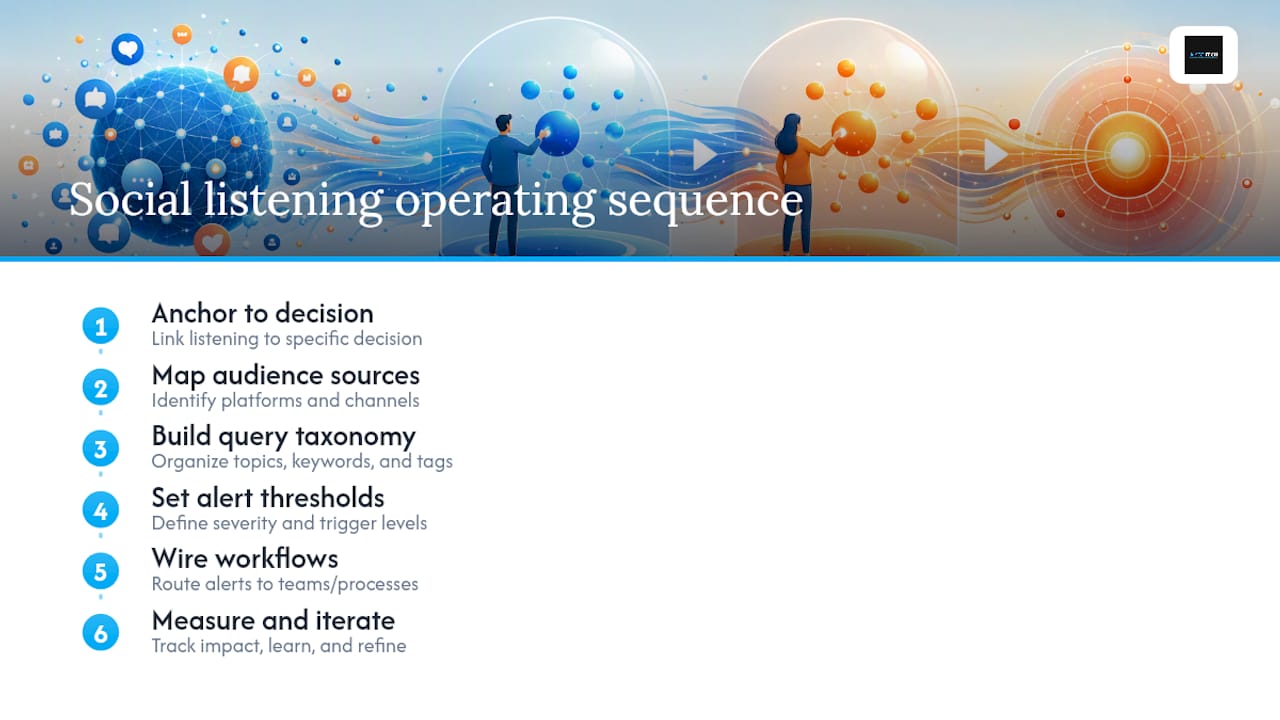
Step 1: Anchor to one decision
Write the sentence before you touch a tool. Practitioner guidance is consistent on this point: teams that anchor listening to a single decision are far more likely to actually ship changes than teams that start by buying software and figuring out the use case later, according to Mentient’s operational framework.
Templates that work:
- “This program tells us when negative sentiment about [feature] crosses [threshold], so support can [action].”
- “This program tells us which competitor complaints spike month over month, so product marketing can [action].”
- “This program tells us when a crisis narrative starts trending, so comms can [action] within [timeframe].”
Step 3: Build a query taxonomy with exclusions
A taxonomy is a set of tagged, testable queries organized by decision, not just by keyword. Group queries under themes tied to the decision from Step 1: product complaints, competitor mentions, crisis keywords, campaign hashtags. Each group needs an exclusion list to filter homonyms, unrelated brands, and spam accounts before you ever look at the results.

Step 4: Set three alert tiers and assign owners
Alert fatigue kills more listening programs than bad data does. A three-tier framework mapped to named owners cuts noise dramatically and improves how fast teams actually respond, according to Pulsar’s practitioner research.
The three tiers:
- Routine: normal volume and sentiment fluctuation. Reviewed weekly, owned by the insights analyst.
- Elevated: sentiment or volume crosses a defined threshold (say, a 20% spike in negative mentions in 24 hours). Reviewed same-day, owned by the channel lead.
- Critical: signals of reputational or safety risk, viral negative narrative, or executive-level exposure. Reviewed within the hour, owned by a named comms lead with escalation authority.
Step 5: Tagging, sentiment audits, and workflow wiring
Tags need to map to decisions, not just topics. “Pricing complaint” is a decision-relevant tag; “mentions the word ‘price’” is not. Build your taxonomy so a product manager or a comms lead can filter directly to the tag that matters to them without wading through irrelevant volume.
Sentiment scoring out of most tools runs roughly 70% to 80% accurate before any tuning. Audit against at least 100 manually labeled examples every quarter. If accuracy sits below 80%, either retrain the model on your own labeled set or treat the sentiment score as directional only, not a hard number you report to leadership.
Wire the tagged, audited output into the workflow tools your teams already use, whether that’s a support ticketing queue, a product roadmap board, or a CRM record, so insights land where action happens instead of sitting in a listening dashboard nobody opens.
Step 6: Measurement, cadence, and continuous improvement
Set a review cadence before launch: daily glance at routine alerts, weekly review of theme trends, monthly strategy session tied back to the original decision sentence. Revisit the query taxonomy every quarter. Language shifts, new slang appears, and competitors rebrand.
How Do You Write and Test Social Listening Queries?
A working query has five components: brand and product name variants, common misspellings, relevant hashtags, emoji variants where they carry meaning, and an exclusion list to strip out noise. Skip the exclusion list and you’ll drown a promising signal in irrelevant mentions within a week.
Broad queries cast wide for early discovery. Narrow queries get precise once you know what you’re looking for.
| Query type | Example | Best use |
|---|---|---|
| Broad | "[brand]" OR "[misspelling]" |
Early-stage discovery, baseline volume |
| Narrow | "[brand]" AND ("refund" OR "cancel") |
Churn-risk or complaint tracking |
| Exclusion-heavy | "[brand]" NOT ("[unrelated homonym]" OR "job posting") |
Cleaning noisy broad queries |
| Campaign-specific | "#[hashtag]" OR "[campaign phrase]" |
Real-time campaign reaction tracking |
Test before you scale. Pull a two-week sample, manually review the first 200 results, and check what percentage is genuinely relevant. Pulsar’s recommended benchmark targets a noise rate under 20%. Anything higher means your exclusions need work before you build dashboards or alerts on top of that query.
Date-stamp every query version you test. When noise creeps back in months later, a versioned history lets you revert instead of rebuilding from scratch. If your platform supports query-understanding features like semantic query matching, use them to catch variant phrasing your Boolean logic would otherwise miss.
What Should You Look for in a Social Listening Tool?
Evaluate platforms against the decision you wrote in Step 1, not against a generic feature checklist. Five criteria actually predict whether a tool will serve that decision:
- Source coverage: does it reach the platforms and forums your specific audience uses, not just the major networks?
- Historical data depth: can you pull 12 to 24 months back to establish a real baseline, or does it only start counting from signup?
- Export and API access: can data flow into your CRM, sales dashboard, or BI tool, or is it locked inside a proprietary interface?
- Alert speed: how fast does critical-tier volume trigger a notification, measured in minutes, not hours?
- Analysis depth: does sentiment scoring and theme clustering hold up against your quarterly manual audit, or does it drift?
During any trial period, ask vendors directly how their sentiment model was trained, what languages it covers beyond English, and how they handle data retention and privacy compliance for the regions you operate in. A platform that can’t answer the privacy question clearly is a governance risk, not just a feature gap.
Which Metrics Actually Prove Social Listening Is Working?
The metric that matters most is the one most dashboards skip: insight-to-action count, meaning how many listening findings actually triggered a shipped change, a support policy update, or a campaign edit in a given quarter. A tool generating hundreds of alerts that never change anything is producing noise, not value.
Other KPIs worth tracking:
- Sentiment trend by theme (not one blended score across the whole brand).
- Emerging theme velocity, meaning how fast a new complaint or compliment cluster grows week over week.
- Response time by alert tier, measured against the SLA you set for routine, elevated, and critical.
- Volume-to-relevance ratio, tracking how much of your total mention volume actually passes your exclusion filters.
Only 22% of communications leaders currently use scenario simulation and just 11% use narrative intelligence in their listening programs, according to Gartner’s research, which means most executive reporting today still runs on trend lines and sentiment shifts rather than predictive modeling. Build your reporting cadence around what’s actually measurable: daily glances at routine alerts, weekly theme reviews, and a monthly one-pager for leadership that leads with insight-to-action count, not raw mention volume.
How Do You Turn Listening Insights Into Shipped Decisions?
Insights die in queues without clear routing. Assign a named owner to each alert tier, not a team inbox. Routine alerts go to the insights analyst for weekly synthesis. Elevated alerts go to the relevant channel lead the same day. Critical alerts go straight to a comms lead with authority to escalate to legal or executive leadership within the hour.
- Elevated tier SLA: same-day acknowledgment, response plan within 24 hours.
- Critical tier SLA: acknowledgment within 60 minutes, executive briefing within 4 hours.
- Quarterly audit questions: How many insights became shipped changes? Which tags produced zero action for two consecutive quarters and should be retired? Where did sentiment accuracy fall below 80% and need retraining?
Pro Tip: If a tag hasn’t produced a single action in two quarters, cut it. A shrinking, high-signal taxonomy beats a bloated one that looks thorough in a slide deck.
What Will AI Add to Social Listening in 2026?
AI is expanding what listening tools can do, but adoption of the advanced features is still early. Expect three capabilities to mature this year: scenario simulation, which models how a narrative might spread before you respond; narrative intelligence, which tracks how a story evolves across platforms rather than just counting mentions; and multimodal analysis, which reads sentiment and brand signals in images and video, not just text.
Right now, only 22% of communications leaders use scenario simulation and 11% use narrative intelligence, according to Gartner. That gap is the opportunity, but it’s also the risk. AI can accelerate insight extraction, yet it still needs human review to catch context the model misses, whether that’s sarcasm, regional slang, or a cultural reference the training data never saw.
Practical guardrails before you lean on these features:
- Run a monthly audit comparing AI-flagged sentiment against a human-labeled sample.
- Check language and regional coverage explicitly. Most models perform worst outside English and outside the market they were trained on.
- Treat any AI-generated “predicted narrative spread” as a hypothesis for a human to validate, not a finished forecast to act on unsupervised.
Enterprise platforms are also building out multimodal signal detection, including logo and image recognition, as an advanced feature set worth evaluating once your core program is stable, not before.
What Do Real Social Listening Programs Look Like in Practice?
Three short sketches show the playbook working end to end.
- Crisis detection: A mid-size retailer’s critical-tier alert caught a packaging defect complaint cluster growing 40% week over week before it hit local news. The named comms owner triggered a same-day statement and supplier recall, containing the story before it reached national coverage.
- Product feedback: A software company tagged recurring “hard to cancel” complaints for two straight quarters. The insight-to-action count flagged it as a dead-weight tag until product finally redesigned the cancellation flow, and the tag dropped out of the elevated tier entirely the following quarter.
- Campaign optimization: A beverage brand’s routine-tier weekly review spotted a hashtag riffing on their tagline gaining organic traction. Marketing built the next campaign phase directly around that fan-generated angle instead of the originally planned creative.
What Do Most Teams Get Wrong About Social Listening?
The industry sells social listening as a technology purchase. It’s actually a governance discipline, and that distinction gets lost constantly. Most failed programs I’ve seen described in practitioner research didn’t fail because the tool lacked coverage. They failed because nobody wrote down which decision the data was supposed to inform, so every stakeholder pulled the same dashboard toward a different conclusion.
The conventional advice tells you to evaluate platforms first: coverage, pricing, integrations. That’s backward. A team with a mediocre tool and a sharp decision sentence will outperform a team with an enterprise platform and no defined use case, every time. The alert-tier framework and the sentiment audit aren’t nice-to-haves bolted onto a “real” strategy. They are the strategy. Without them, you get either alert fatigue that trains people to ignore the tool, or a sentiment score nobody trusts because it was never checked against reality.
On AI specifically: the excitement around scenario simulation and narrative intelligence is getting ahead of the adoption data.
Prioritize the boring parts first: one decision sentence, a tested query with sub 20% noise, three alert tiers with named owners, and a quarterly sentiment audit. Everything else is optimization on top of a foundation that either exists or doesn’t.
— Prasad
How Aiseo Turns Listening Signals Into Reputation Wins
Listening tells you what people are saying. Turning that into review responses, corrected sentiment, and a stronger search presence is a separate job, and it’s the one Aiseo built ReviewSync to handle. Where a listening platform flags a negative sentiment spike, Aiseo’s reputation management approach connects that signal to automated, on-brand responses across review platforms so the insight doesn’t stall at the alert stage.
If you’re already running the alert tiers and query taxonomy described above, the next gap is usually operational: who actually responds when the elevated-tier alert fires on a review site instead of social media. That’s the exact seam ReviewSync and Aiseo’s broader AI-driven marketing services are built to close, pairing sentiment tracking with response automation and reporting your team can hand straight to leadership. Visit Aiseo to see how a listening insight turns into a managed review response instead of another unread dashboard alert.
Sources
Not every platform matters equally for every brand. A B2B software company’s real conversation lives on LinkedIn, niche forums, and review sites, not TikTok. A consumer beauty brand needs the opposite weighting. Pew Research’s usage data on platform demographics is a useful sanity check before you commit budget to sources your actual audience barely touches.
Rank your sources by where your specific customer base actually argues, complains, and recommends, not by platform popularity in general.
- Tech-enabled reputation management — Gartner
- Daily social media usage worldwide — Statista
- Social Listening: Definition, Tools, and Strategies for Business Growth — Coursera
- How to set up a social listening strategy — Pulsar
- How to Build a Social Listening Strategy — Mentient