Fix Pages Fast: Content Refresh for SEO Teams With 56 Day GSC Baseline

A content refresh updates the proof layer, headings, and above-the-fold claim on an existing page while keeping its URL, schema, and internal links intact. A rewrite replaces the thesis and often the URL. Use a refresh when a page still earns impressions or backlinks but has lost clicks or AI citations. Expect measurable movement within weeks and fuller results in 30 to 90 days.
TL;DR:
- Pages ranking between positions 8 and 15 with rising impressions are prime candidates for refreshes, as they are close to moving onto page one.
- Conducting an audit using Google Search Console, GA4, and a crawl tool before refreshing ensures prioritization is based on concrete data, not guesses.
- Avoid changing URLs during a refresh, and only update the “last updated” date after making substantive content changes to prevent ranking risks.
- Updating proof-layer elements like statistics, screenshots, and schema markup is crucial, as AI citations often favor fresher content within two weeks.
- Scaling a refresh program requires batching quick fixes for well-performing pages and dedicating individual attention to full rewrites for content with significant topical drift.
Table of Contents
- When to Refresh: Triggers and Prioritization
- Audit: Exact Data to Collect and the Tools to Use
- Decide: Refresh, Rewrite, or Consolidate
- What to Update: Prioritized On-Page Edits and Proof-Layer Fixes
- Execution Workflow: Delta Brief, Tagging, Staging, and Publishing
- Measure Results and Expected Timelines
- Scaling a Refresh Program and Cadence
- Publisher Expertise: How Aiseo Applies the Refresh Workflow
- Editorial Perspective: Lessons From Running Refresh Programs
- How Aiseo Helps Teams Scale a Content Refresh Program
- Sources
- FAQ
When to Refresh: Triggers and Prioritization
Not every underperforming page deserves attention right now. The trick is separating pages that are decaying from pages that are simply dead.
Five signals reliably flag a page as refresh-ready:
- A steady drop in average position over 60 to 90 days despite stable backlink counts.
- Falling click-through rate even when impressions hold steady, which usually points to a stale title or snippet.
- Loss of AI citations in tools like ChatGPT or Perplexity for queries the page used to answer.
- A proof layer built on outdated statistics, dead screenshots, or pricing that no longer matches reality.
- Competitors publishing fresher, more specific versions of the same topic and outranking you on it.
Once you’ve flagged candidates, score them instead of guessing. A simple formula works: multiply potential impact (current impressions plus historical peak traffic) by ease of fix (how much actually needs to change) and divide by decay risk (how fast the topic ages, since a “best tools” list decays faster than an evergreen how-to).
Pull the raw numbers from Google Search Console and GA4 before you commit to anything. Sort by pages with impressions above your site median but clicks trending down, then cross-reference average position. A page sitting at position 8 to 15 with rising impressions is a much better refresh bet than a page stuck at position 40, because the first is one nudge away from page one and the second likely has a deeper relevance problem a refresh won’t fix.
Established sites get most of their traffic from older content in the first place. A 2025 Contentful analysis found that the majority of monthly blog views for established sites come from posts published before the current month, which is the single best argument for spending your next sprint on old blog posts instead of another net-new article nobody will read for six months.
Audit: Exact Data to Collect and the Tools to Use
A refresh without an audit is just guessing with extra steps. Pull the following in order, every time, so your prioritization scoring stays consistent across pages:
- Google Search Console: Export queries, impressions, clicks, and average position for each candidate URL. Lock a 56-day window before you touch anything. Search Engine Land’s reported workflow uses this exact 56-day baseline so seasonal noise doesn’t get mistaken for a real ranking shift, and so you have a clean before/after comparison once the refresh publishes.
- GA4: Pull engagement rate, average time on page, and any conversion events tied to that specific URL, whether that’s a form fill, an add-to-cart, or a newsletter signup. A page can rank fine and still fail the business if nobody converts once they land.
- Crawl inventory: Run a crawl with Screaming Frog or Sitebulb to capture last modified date, current word count, outgoing link count, and how many internal pages link to the URL. Pages with strong internal link equity are worth protecting carefully during edits.
- Competitor SERP analysis: Check who currently outranks the page and note what they cover that you don’t. Gaps in subtopics, missing comparison tables, or thinner proof layers are common findings.
- AI citation checks: Search the page’s target queries directly in ChatGPT, Perplexity, or Google’s AI Overviews and note whether your domain appears. Do this before publishing changes so you have a real baseline, not a guess.
Behavioral tools like Microsoft Clarity add a layer the numbers alone won’t show you: scroll maps and session recordings reveal exactly where readers stop reading, which often points straight to the paragraph that needs the fix.
Decide: Refresh, Rewrite, or Consolidate
Three options exist, and picking the wrong one wastes the entire cycle. Each preserves or discards different assets:
- Refresh: Keeps the URL, schema, and internal links. Changes statistics, examples, headings, and the above-the-fold claim. Use this when the topic and thesis are still correct but the evidence is old.
- Rewrite: Replaces the thesis, and sometimes the URL. Use this only when the original angle is now wrong, not just outdated. A “best software of 2020” post rarely needs a rewrite. A post built around a deprecated product category does.
- Consolidate: Merges two or more thin, overlapping pages into one stronger URL, with 301 redirects pointing the losers to the survivor. Use this when several pages compete for the same query and split your own authority.
Decision criteria should follow rank band and backlink profile. A page ranking in positions 5 to 20 with an active backlink profile is a refresh candidate almost every time, since a rewrite risks throwing away equity you’d have to rebuild. A page buried past position 50 with no backlinks and clear topical drift from your current strategy is a rewrite or consolidation candidate.
Two conservative rules keep refreshes safe. Never change the URL during a refresh; that single move is what turns a low-risk edit into a high-risk one. And only update the visible “last updated” date after you’ve made substantive edits, not as a cosmetic trick to look fresh. Practitioner guidance consistently backs preserving the URL as the core rule of a safe refresh.
What to Update: Prioritized On-Page Edits and Proof-Layer Fixes
The proof layer is where most refreshes win or lose. That’s the layer of statistics, screenshots, examples, and sourced claims that convince both a reader and an AI model that the page is trustworthy right now, not trustworthy two years ago.
Work through edits in this order:
- Replace outdated statistics and swap dead or expired sources for current ones.
- Update any screenshots, pricing tables, or product examples that no longer reflect reality.
- Rewrite the headline and opening text to clearly state the core claim, since AI systems tend to pull from the start of a section rather than from deeper paragraphs.
- Add sections that close clear competitor gaps you found in the audit; leave sections that already perform well untouched.
- Update schema markup, particularly
dateModifiedand FAQ schema, so search engines and AI crawlers register the change. - Convert images to modern formats like WebP or AVIF and refresh alt text tied to the updated content.
- Review internal links pointing to and from the page, and add links to newer, relevant content published since the original went live.
Indexly’s analysis of AI citation behavior found that AI-cited content tends to be notably fresher than typical organic winners, which is a strong argument for structuring each section as one clear claim followed by supporting detail, rather than burying the answer three paragraphs deep. Macrolight Builder’s guidance on earning AI citations makes the same point from a different angle: passage-level clarity beats narrative buildup when a model is scanning for a quotable answer.
Pro Tip: Fix the proof layer before you touch anything else. Updated statistics, one new section, and refreshed screenshots often recover AI citations within roughly two weeks, well before a full rewrite would even clear editorial review.

Execution Workflow: Delta Brief, Tagging, Staging, and Publishing
A refresh scales only when the workflow is repeatable. Here’s the sequence that keeps edits controlled and measurable:
- Tag every section of the existing page as keep, fix, remove, or add. This single step prevents editors from rewriting sections that were already working.
- Write a delta brief covering only the fix and add sections. Search Engine Land’s documented workflow treats the delta brief like an engineering change request: specific reason for each change, precise instructions, and no vague “make it better” notes.
- Lock your 56-day GSC baseline before publishing anything. Screenshot or export the data so you have a fixed comparison point.
- Run a staging checklist: confirm the slug hasn’t changed, validate schema with a structured data testing tool, check that internal links still resolve, and confirm image dimensions and formats meet current specs. WordPress site health checks cover several of these automatically if you’re on that CMS.
- Publish the update and update the visible modified date.
- Request indexing through Google Search Console, and where available, use the Indexing API or IndexNow so search engines and AI crawlers pick up the change faster. Google’s own documentation covers how refresh and recrawl requests are processed, including the pending and approved states you’ll see in the console.
- Start the post-publish clock using the same 56-day window you locked at baseline, so your before and after comparison stays apples to apples.
Measure Results and Expected Timelines
Track four Search Console metrics against your locked baseline: clicks, impressions, average position, and CTR. Pair those with GA4 conversions or events tied to the page’s actual business goal, since ranking gains that don’t move conversions are only half a win.
AI citation tracking runs on its own clock. Check your target queries in ChatGPT, Perplexity, or Google’s AI Overviews at day 7, day 14, and day 30 after publishing, since these systems tend to weight freshness heavily and often respond faster than traditional rankings do.
| Metric | Where to check | Typical early signal | Fuller signal |
|---|---|---|---|
| Clicks and impressions | Google Search Console | 2 to 6 weeks | 30 to 90 days |
| Average position | Google Search Console | 2 to 6 weeks | 30 to 90 days |
| Conversions/events | GA4 | 4 to 8 weeks | 60 to 90 days |
| AI citation presence | Manual checks in AI tools | 7 to 14 days | 30 days |
If nothing moves by day 30, don’t assume the refresh failed outright. Check whether Google actually recrawled the page, whether a competitor published something stronger in the same window, or whether the real problem was topical relevance rather than freshness. Indexly’s practitioner data found proof-layer fixes recovering AI citations within roughly 14 days and organic rank improving within 4 to 8 weeks, which is a useful benchmark for deciding whether your timeline is normal or a warning sign.
Scaling a Refresh Program and Cadence
Running one refresh is easy. Running fifty a quarter without breaking quality is the actual challenge.
Start by splitting your backlog into quick refreshes and full rewrites, and resist the urge to treat every page the same way:
- Quick refreshes suit pages where the thesis holds and only the proof layer or above-the-fold claim needs work; these can often be batched five or ten at a time using a shared delta brief template.
- Full rewrites suit pages with genuine topical drift, and they deserve individual attention rather than a template.
- Quality gates matter at scale: fact-check every updated statistic, verify every proof-layer claim against its current source, and run a final editorial pass for tone consistency before publishing.
- Tooling can absorb the repetitive parts. Platforms built for AI-assisted content workflows can pull audit signals and draft outline-level delta briefs, leaving editors to focus on judgment calls rather than data collection.
One editor can realistically manage the fact-checking and quality gate for a batch of quick refreshes, while full rewrites need the same attention a new article would get.
Publisher Expertise: How Aiseo Applies the Refresh Workflow
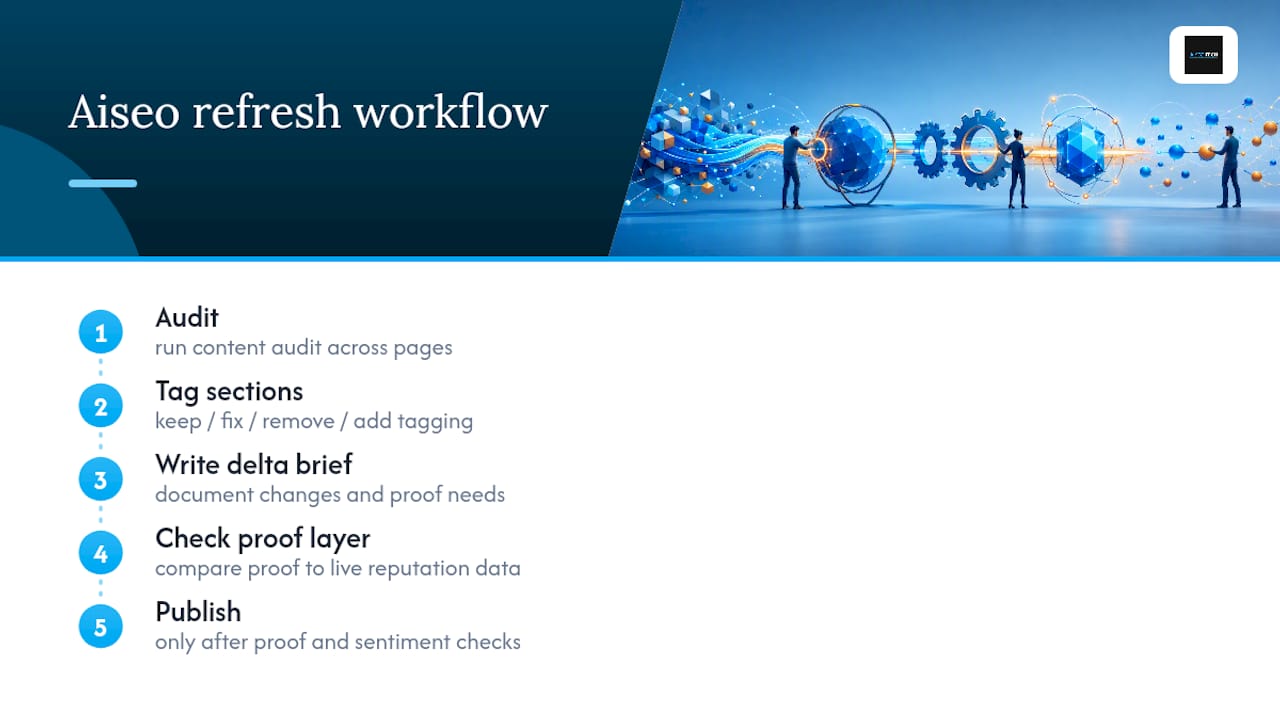
This workflow isn’t theoretical for the company. The delta brief, keep/fix/remove/add tagging, and 56-day baseline described above are the same steps used in their approach to client content programs, paired with reputation and review data from a review platform.
That combination matters because a proof layer isn’t just statistics and screenshots. For a local business, outdated customer sentiment on a page is just as damaging as an outdated chart. Mapping sentiment tracking against a page’s proof layer means a delta brief can flag not just a stale statistic but a testimonial that no longer reflects current review volume or rating.
A typical engagement runs the audit, tags sections, writes the delta brief, and checks the proof layer against live reputation data before anything publishes, keeping the refresh grounded in current customer sentiment rather than outdated information.
Editorial Perspective: Lessons From Running Refresh Programs
The most common mistake isn’t skipping the audit. It’s changing the URL or slapping a new “updated” date on a page nobody actually edited, which fools nobody, least of all an AI model checking for real freshness signals.
The second most common mistake is over-editing pages that were already working, which breaks tone consistency for no measurable gain. Small, targeted proof-layer fixes tend to recover AI citations faster than anyone expects, often before a full rewrite would even finish review.
If there’s one habit worth adopting above all others, it’s this: lock your baseline before you touch anything, and measure against that exact window every time.
— Prasad
How Aiseo Helps Teams Scale a Content Refresh Program
This company provides an alternative to hiring a full in-house content operations team for running a refresh program at scale. Instead of building audit spreadsheets and delta brief templates from scratch, their AI-driven tools pull audit signals, draft delta briefs, and cross-check proof-layer claims against live reputation data, so teams spend time on editorial judgment instead of data entry.
This fits teams with limited bandwidth for manual audits, businesses juggling proof-layer claims across multiple review platforms, or anyone who needs cross-channel measurement tying content performance to real reputation signals rather than rankings alone. Aiseo’s search everywhere optimization approach is built specifically around the AI citation and freshness signals this article covers.
If your backlog of aging pages is bigger than your team’s capacity to fix it, explore what Aiseo’s reputation and marketing services can do for your growth and request a walkthrough of how the audit and delta brief process would apply to your own content.
Sources
- Contentful — Content lifecycle management (blog)
- Search Engine Land — How to scale SEO content updates with Claude Code
FAQ
What Is a Content Refresh?
A content refresh updates an existing page’s statistics, examples, headings, and above-the-fold claim while keeping its URL, schema, and internal links intact, as opposed to a rewrite, which replaces the thesis.
What Is the 80/20 Rule in SEO?
Applied to content, it means a small share of your pages, often the older, established ones, generate most of your traffic. Contentful’s research found 76% of monthly blog views for established sites come from older posts, which is why refreshing that older content usually beats publishing net-new articles.
What Are the 3 C’s of SEO?
Definitions vary across practitioners, but a common version refers to content, code, and credibility: the quality of what’s on the page, the technical structure behind it, and the trust signals (backlinks, reviews, sourcing) that support it.
Is SEO Dead Now With AI?
No. AI search tools like ChatGPT and Perplexity still pull from indexed, crawlable web content, and freshness is one of the signals they weight heavily when deciding what to cite, which makes ongoing content refresh work more relevant, not less.
How Often Should I Refresh a Page?
There’s no fixed schedule. Refresh whenever your audit signals show a page losing clicks, AI citations, or ranking position despite still holding impressions or backlinks, then measure against a locked 56-day baseline before deciding if it worked.