90 Day Entity SEO Playbook for SEO Teams: Build an Entity Map & Schema

Entity SEO means optimizing your content around real world things, people, and organizations, and the relationships between them, instead of chasing keyword strings. The single highest impact move you can make right now is to map your most valuable pages to a canonical entity, then back that mapping with Organization, Product, or Article schema that includes an @id and mainEntityOfPage. Everything else, from Knowledge Graph visibility to AI Overview citations, builds on that foundation.
TL;DR:
- Mapping each page to a specific entity and including schema with @id and mainEntityOfPage is critical for effective entity SEO.
- Using external identifiers like Wikidata and consistent internal linking strengthens entity recognition and disambiguation.
- Building and maintaining a detailed entity map that documents relationships and ownership ensures ongoing accuracy and relevance.
- Implementing schema types such as Organization, Product, Person, and Article with correct attributes enhances knowledge panel appearances and AI answer accuracy.
- Measuring success involves tracking broader query clusters and using NLP tools to ensure content accurately reflects the targeted entities.
Table of Contents
- What Is an Entity, and How Is It Different From a Keyword?
- How Does Google’s Knowledge Graph Use Entities?
- What Does an Entity-First Strategy Actually Look Like?
- How Do You Implement Entity SEO on Your Pages?
- How Do You Measure Whether Entity SEO Is Working?
- What Does an Entity Migration Look Like in Practice?
- What Actually Moves the Needle in an Entity SEO Rollout?
- How Aiseo Helps You Build an Entity-First Foundation
- Where to Go Deeper on Entity SEO
- Sources
What Is an Entity, and How Is It Different From a Keyword?
An entity is a distinct, identifiable thing: a person, a place, an organization, a product, an event, or an abstract concept. “Aiseo” is an entity. “Reputation management” is an entity. “Best reputation management software” is a keyword, and it only exists because a search engine needs to match human phrasing to the entities behind it.
Every entity carries attributes and relationships. A business entity has attributes like founding year, headquarters, and service categories. It has relationships to other entities: the industry it belongs to, the clients it serves, the partners it works with. Google’s systems don’t just index the words on your page anymore. They try to figure out which entity your page is about, then connect that entity to everything else it already knows.
That distinction matters for a practical reason: keyword optimization helps you rank for one phrase. Entity clarity helps you rank across an entire cluster of related queries, because the engine understands the underlying concept rather than pattern matching text strings.
Here’s what shifts once your entity signals are clear:
- Search engines can disambiguate your brand from similarly named competitors or unrelated terms.
- Your page becomes eligible to surface in answer boxes, Knowledge Panels, and AI Overviews built on entity data, not just keyword density.
- Related queries you never explicitly targeted start pulling traffic, because the engine recognizes the entity relationship, not just a text match.
- Content built around context-rich passages that define services and their relationships helps extraction systems resolve which entity a page is actually about, cutting down on ambiguity that keyword-only pages create.
This is the conceptual shift behind entity based SEO: you’re no longer optimizing text for a query, you’re optimizing a concept for a graph.
How Does Google’s Knowledge Graph Use Entities?
Google’s Knowledge Graph is a structured database of entities and the facts connecting them. It doesn’t store keywords. It stores nodes (entities) and edges (relationships), and it has done so at scale since Google launched the feature in 2012, according to Wikipedia’s account of the Knowledge Graph. When you search “AISEO Tech,” Google isn’t just matching text on a page. It’s checking whether an entity by that name exists in its graph, what it’s connected to, and whether your page is a trustworthy source of facts about it.
Named entity recognition (NER) and entity linking are the mechanical processes behind this. NER identifies which spans of text refer to a real-world entity. Entity linking then connects that mention to a specific node in the graph, resolving ambiguity along the way (is “Amazon” the river or the company?). This is precisely why sameAs and @id matter in your schema: they give the linking process an explicit, machine-readable pointer instead of forcing it to guess from context.
Google’s entity data now does more than power Knowledge Panels. Ahrefs’ explainer on the Knowledge Graph notes that the graph’s facts and relationships are used to enrich AI generated answers directly, which means your entity signals feed both classic SERP features and the newer answer engine layer.
Quick stat check: there’s no single public figure for “how many queries trigger Knowledge Panels,” but the mechanism is consistent across both surfaces AISEO Tech tracks for clients: Knowledge Panels and AI Overviews both pull from the same underlying entity graph, not from independent ranking signals.
Three things Google’s entity systems are doing whether you’ve optimized for them or not:
- Disambiguating your brand name against homonyms, competitors, and unrelated concepts.
- Grounding AI-generated summaries in facts it can verify against known entities, rather than generating them purely from language patterns.
- Deciding whether your page is authoritative enough about an entity to cite, quote, or feature in a panel.
The practical takeaway: if your site has never explicitly told Google which entity each page represents, you’re leaving that disambiguation process to chance.
What Does an Entity-First Strategy Actually Look Like?
Entity-first strategy starts with a document most SEO teams don’t have: an entity map. This is a working record of every canonical entity your site represents, one entity per page, along with its relationships to other entities and any external identifiers you can attach to it, like a Wikidata Q-ID or an internal content ID.
Building one is less complicated than it sounds. Here’s the sequence that works for most sites:
- List your core entities. Your organization, your key products or services, notable people (founders, authors), and any concepts central to your niche.
- Assign one canonical page per entity. If three blog posts all sort of cover “reputation management,” pick one to be the authoritative page and have the others link to it with consistent anchor text.
- Document relationships. Note how entities connect: “AISEO Tech” offers “ReviewSync,” which belongs to the category “reputation management software.”
- Attach identifiers where they exist. Link to a Wikidata entry, a Wikipedia page, or at minimum keep an internal ID scheme so your own systems don’t drift on naming.
- Assign ownership. Decide who updates the map when a product launches or a page gets rewritten, because an entity map that nobody maintains decays within a quarter.
That last step is where most teams stumble. Entity work touches editorial (who writes the definitional content), development (who implements the schema), and analytics (who tracks whether it’s working), and if none of them owns the map, it goes stale fast.
Pro Tip: Treat your entity map like a style guide, not a one-time audit. Store it somewhere editors actually check before publishing, so a new landing page gets its @id and canonical entity name assigned before launch, not retrofitted three months later.
Is entity-first work worth the investment for every site? Not immediately. A five-page brochure site with no content velocity gets diminishing returns from a full entity map. The investment pays off when you have real content volume, a competitive niche where disambiguation matters (a common brand name, overlapping product categories), or ambitions around AI Overview visibility, where consistent schema and corroborating mentions increase the odds of being cited. If you’re publishing weekly and competing against brands with similar names, this is worth doing now rather than later.
How Do You Implement Entity SEO on Your Pages?
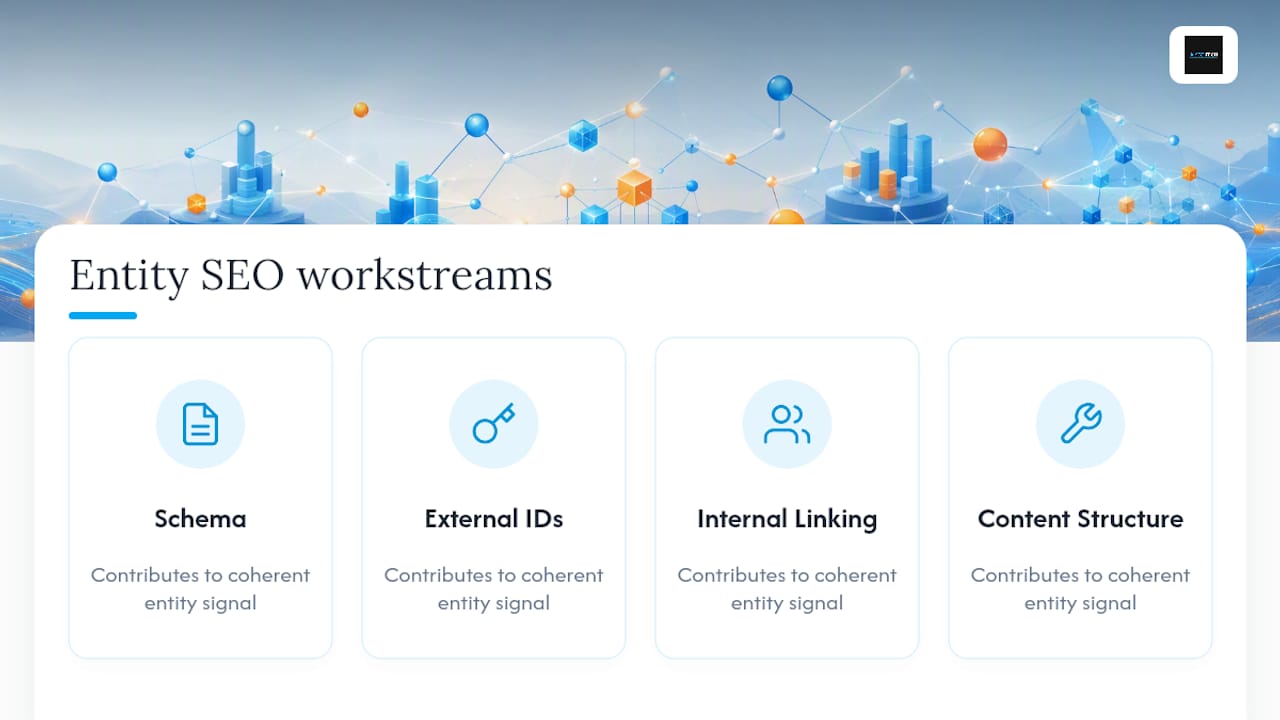
Implementation breaks into four workstreams: schema, external identifiers, internal linking, and content structure. Get all four roughly right and you have a coherent entity signal. Skip one, and the others do less work than they should.
Schema priorities
Not every schema type carries equal weight for entity recognition. Start with these, in this order:
- Organization schema on your homepage or about page, with
@id,name,url, and asameAsarray pointing to your verified social profiles and any Wikidata entry. - Product or Service schema on commercial pages, again with
@idso the product entity connects explicitly to the Organization entity that offers it. - Person schema for named authors or founders, particularly if you’re building any kind of authority around individual expertise.
- Article schema with
mainEntityOfPagepointing back to the canonical URL, which tells engines exactly which page is the authoritative source for that content.
Practitioners building entity-first strategies treat this bundle as the “entity foundation”: consistent markup across Organization, Product, and Person types, plus titles and H1 tags that match the canonical entity name rather than a keyword variant.
Wikidata and sameAs
If your organization, a key product, or a named executive has a Wikidata entry, link it via sameAs. If one doesn’t exist and you genuinely meet notability standards, creating one is a legitimate, if slow, corroboration tactic. Authoritative external identifiers function as machine-readable proof that the entity described on your site is the same entity referenced elsewhere on the web. Skip this step for entities that don’t warrant a public identifier. Forcing a Wikidata page for a minor product line usually isn’t worth the effort.
Entity-based internal linking
Hub-and-spoke structures work well here. Your canonical entity page is the hub; supporting content that touches related subtopics links back using consistent, descriptive anchor text tied to the entity name, not generic phrases like “click here” or “learn more.” If your canonical page for “answer engine optimization” is linked from a dozen posts using a dozen different anchor phrases, you’re diluting the entity signal instead of reinforcing it.
Content signals that help extraction
Definitional clarity in your prose matters as much as your markup. A short, direct definition passage near the top of a page (what this entity is, in one or two sentences) gives extraction tools an anchor point. Attribute lists, subject predicate object statements (“ReviewSync manages reviews across multiple platforms”), and explicit disambiguation lines (“not to be confused with X”) all reduce ambiguity. The failure mode to avoid is entity stuffing, repeating an entity name unnaturally throughout a page hoping it reinforces relevance. It doesn’t. It reads as spam to both algorithms and readers.
| Signal type | What it does | Where to implement |
|---|---|---|
Organization schema with @id/sameAs |
Confirms brand entity identity | Homepage, about page |
| Product/Service schema | Links offerings to the parent entity | Commercial and service pages |
mainEntityOfPage |
Declares canonical source for content | Blog posts, articles |
Wikidata sameAs |
External corroboration of identity | Organization/Person schema |
| Entity anchored internal links | Reinforces topical hub structure | Supporting content pages |
How Do You Measure Whether Entity SEO Is Working?
Measurement here is different from tracking keyword rank, because you’re checking whether a concept is understood, not whether a phrase matches. Start with Google Search Console, but look at query clusters tied to your entity rather than single-keyword impressions. If your canonical “reputation management” page starts pulling impressions from a wider spread of related queries you never explicitly targeted, that’s the clearest sign the entity signal is registering.
Beyond GSC, entity extraction tools let you check your own work before Google does. Run your key pages through the Google NLP API or TextRazor and see which entities they surface as salient. If the tool pulls out the wrong primary entity, or misses your intended one entirely, your content needs clearer definitional language before schema will fix it. Embeddings offer a second layer of verification: measuring semantic alignment via embeddings and NLP is a practical way to confirm a page is conceptually close to its target entity, not just keyword adjacent to it.
A short toolkit that covers most of this work:
- validator.schema.org to catch malformed JSON-LD or missing required properties before you deploy anything.
- Google NLP API or TextRazor to check which entities your content actually surfaces as salient.
- InLinks or WordLift for building and visualizing an internal entity graph as your content library grows.
- Google Search Console for tracking impression spread across entity-related query clusters over time.
On timelines: entity signals aren’t instant. Schema changes can get recrawled within days, but shifts in Knowledge Panel data or AI Overview citation frequency typically take longer to show up, often a full quarter of consistent signal reinforcement before you see a measurable pattern. Set your KPI checkpoints accordingly: schema validation and NLP entity checks weekly, impression cluster analysis monthly, panel or citation appearance quarterly.
What Does an Entity Migration Look Like in Practice?
Here’s a small, concrete version of this work rather than a theoretical one. Take a single service page, say, a reputation management landing page, and walk it through an entity migration.
First, decide the canonical entity: “AISEO Tech’s ReviewSync platform,” not the vaguer “review management services.” Rewrite the H1 and meta title to match that canonical name rather than a keyword phrase that only loosely maps to it. Add Product schema with an @id unique to that page, a sameAs reference if a relevant external profile exists, and mainEntityOfPage pointing to the canonical URL itself. Link the Product entity to an Organization schema block elsewhere on the site so the two connect explicitly in the graph rather than by implication.
A working checklist for this kind of migration:
- Titles and H1s rewritten to match the canonical entity name, not a keyword variant.
- Schema added or corrected, with
@idpresent on every entity block. sameAspopulated wherever a legitimate external profile exists.- Internal links from related pages updated to consistent, descriptive anchor text.
- External mentions (press, partner sites, directories) checked for name and category consistency.
That last point connects to a signal worth taking seriously: strategic co-citation, being mentioned alongside recognized entities on third-party sites, functions like a modern form of backlink for entity recognition, often doing more for identity corroboration than another link from your own domain ever could.
What Actually Moves the Needle in an Entity SEO Rollout?
Three priorities beat everything else when you’re starting from zero: build the entity map before you touch a single schema tag, keep schema consistent across every page rather than perfect on one page, and chase corroborating mentions from other sites instead of assuming your own markup is enough to convince anyone. Most teams get the order backward. They deploy beautiful JSON-LD on a landing page nobody else references, then wonder why nothing changed.
The most common mistake I see is treating entity SEO as a schema project rather than a naming discipline. If your About page calls you “AISEO Tech,” your schema calls you “AISEO,” and your Wikidata entry (if you have one) calls you something else entirely, you’ve built ambiguity into your own foundation. Fix the naming first.
A pilot that respects a real team’s bandwidth: Month one, build the entity map and audit existing schema gaps. Month two, implement schema and fix internal linking on your top ten pages by traffic. Month three, run NLP extraction checks, correct what’s misread, and start tracking impression clusters in Search Console. Anything more ambitious than that in ninety days usually collapses under its own scope.
— Prasad
How Aiseo Helps You Build an Entity-First Foundation
Some providers offer done-for-you routes to the entity map and schema work many teams never finish on their own, pairing SEO implementation with reputation signals that corroborate brand entities across the web.
Instead of piecing together validator checks, NLP extraction, and schema deployment across three different tools and two different teams, Aiseo’s SEO services handle the entity mapping and structured data implementation directly, while ReviewSync strengthens the external corroboration layer by managing reviews and sentiment across the platforms where your brand entity actually gets mentioned. That combination matters because schema alone doesn’t convince anyone your entity is authoritative. Consistent mentions across a managed review presence do the rest of that work. If your entity signals are scattered across mismatched names, missing schema, and inconsistent external profiles, request an audit from Aiseo to see where the gaps actually are before you spend another quarter guessing.
Where to Go Deeper on Entity SEO
For hands-on technical reference, start with the Schema for exact type definitions and required properties, then validate anything you deploy through Validator. Search Engine Land’s entity-first optimization guide covers the strategic side in more depth, while Backlinko’s entity SEO notes and Ahrefs’ Knowledge Graph explainer round out the conceptual background behind how Google actually uses this data.
Sources
- Entity-first SEO: How to align content with Google’s Knowledge Graph
- Entity SEO (Backlinko)
- Google’s Knowledge Graph explained (Ahrefs)
- Validator